Ground Movement Associated with Pipe Bursting
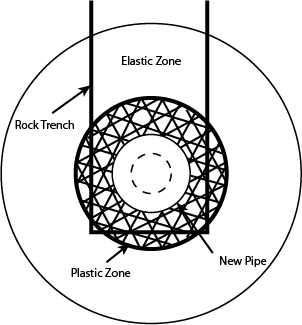
The pipe bursting process creates a cavity in the soil around the pipe where the new pipe is pulled
through. This cavity creates a compression plastic zone around the new pipe outlined by an elastic zone
as indicated below. The magnitude of the compression and the dimensions of these zones correlate with
the amount of upsizing, the diameter of the pipe, and the type of soil (Atalah 1998). The study investigated
the ground movements and vibrations associated with bursting small diameter pipes in soft soils (Atalah 1998)
and with large diameter pipes in rock conditions (Atalah 2004), resulting in guidelines for safe distances
from existing nearby utilities, structures, and pavement. Large diameter bursting in rock conditions is
applicable for upsizing 24" diameter reinforced RCP pipe with upsize percentage less than 50%. Small
diameter bursting in soft soils refers to upsizing 8" and 10" in diameter VCP with upsize percentage
less than 30%. The findings of these studies are summarized in the chart below.
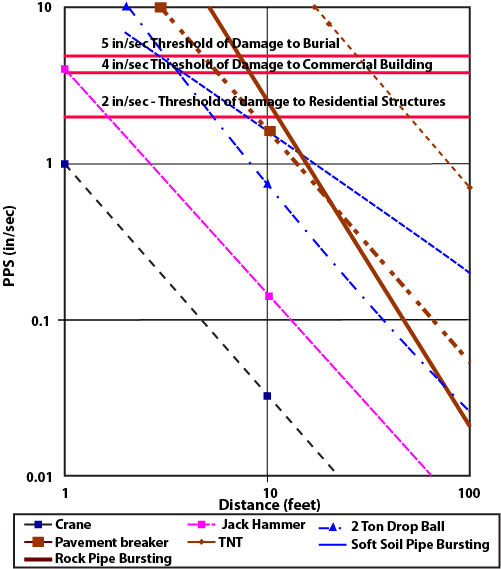
The Attenuation Lines of the PPS vs. Distance from the Source for Different
Construction Equipment (Wiss 1980) and the Attenuations of the 95% Prediction
Interval Upper Limit Lines for Pneumatic Bursting in Soft Soils (Atalah 1998) and
Hard Soils (Atalah 2004)
The above chart compares the peak particle velocity (PPS) of the soil versus the distance from the source
of the vibration for different types of construction equipment and small diameter pipe bursting in soft
soils and large diameter bursting in rock conditions. The PPS is the velocity of soil particles as they
vibrate due to these construction activities. There is a strong correlation between the distance from the
bursting head and the level of vibration for pneumatic bursting. As indicated, the bursting vibration
levels quickly fall to levels that do not cause damage to buildings. For structurally sound residential
buildings, a safe distance (away from these structures) of eleven feet and eight feet are recommended for
large diameter bursting in rock conditions and small diameter bursting in soft soils respectively. Safe
distances of eight feet and four feet from nearby structurally sound commercial structures are recommended
for bursting large diameter bursting in rock conditions and small diameter bursting in soft soils
respectively. In addition, the statistical analysis indicates that 7.5 feet or greater represents a
safe distance from the buried structures. Since the pipes of interest are mostly deep main lines
installed in the right of way, they are usually relatively far from residential or commercial buildings.